Ground isolation isn’t enough: shield‑grounded cables that keep EV powertrain endurance rigs running
If your e‑powertrain endurance rig is tripping on vibration thresholds with the inverter energised, don’t blame the accelerometer first. In real rigs, the dominant EMI path is often the cable/connector, not the sensor mounting point. Your internal ground shows broadband fluctuations vanishing when the inverter is off, persisting when it’s on—even with a ground‑isolated triax—until the lead and terminations are corrected.

What actually couples the noise?
- Through the mounting path (ground loops): mitigated by ground‑isolated or case‑isolated accelerometers.
- Through the cable/connector (radiated & conducted pickup): the lead behaves like an antenna; poor shield continuity and “pigtails” make it worse. With the inverter ON, random broadband fluctuations corrupt the control channel despite sensor isolation—pointing squarely at the cable/connector as the dominant coupling path.
Why cable choice fixes what isolation can’t
Replacing a standard (yet shielded) lead with an EMC‑optimised, shield‑grounded cable—and correcting shield terminations—stabilises the spectrum and eliminates nuisance stops without changing the rig mechanics. The lesson: treat the entire signal chain—sensor isolation and continuous shield grounding through the connector and along the cable.
Recommended chain for EV rigs
Sensors
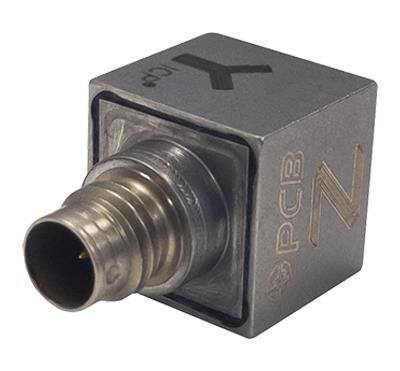
Reduces ground‑loop coupling at the mount.
When structure coupling is complex
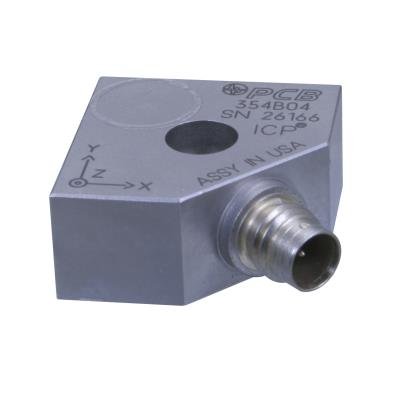
Consider a case‑isolated triax such as 354B04: the housing adds a Faraday‑cage boundary to further suppress interference.
Shield‑grounded cables
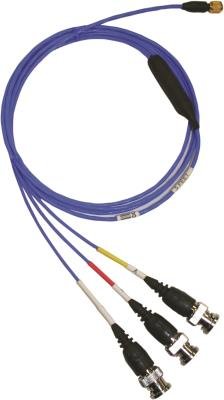
- 034T series: 4‑conductor, low‑noise, FEP; shield‑grounded; 4‑socket to triple BNC. Ideal pairing with ground‑isolated sensors.
- 010T series : 4‑conductor, FEP, shield‑grounded; stranded conductors for better vibration‑fatigue life when harnesses move.
Installation that prevents “mystery noise”
- One ground reference for all returns; avoid daisy‑chained grounds.
- 360° shield terminations at both ends (connector backshells/EMC glands). No pigtails.
- Keep runs short, route away from HV busbars/switching loops, and minimise loop area.
- Inspect connectors (no corrosion, tight backshells); add in‑line low‑pass filtering at DAQ if needed.
Request a visit from a local engineer
Let’s review your assets and objectives on-site: book an onsite meeting and application review.