Navigating the High-Voltage Minefield: Ensuring Safety and Precision in EV Battery Testing

The rapid transition to high-voltage (HV) architectures in electric vehicles (EVs) has introduced a critical challenge for test engineers: how to measure mechanical durability safely in environments reaching up to 2,000 VDC. As battery packs and drive systems become more energised, conventional instrumentation often falls short, posing risks to both equipment and personnel.
The danger of conductive instrumentation
In standard vibration testing, accelerometers typically feature metallic housings, such as titanium or stainless steel. While robust, these cases can act as a fundamental path for electrical signals [source history]. If a metallic sensor accidentally contacts an energised component like a busbar or a battery cell, it can trigger a catastrophic electrical discharge.
This “electrical minefield” can lead to:
- DAQ Destruction: High-voltage surges can travel through the cable, instantly destroying expensive Data Acquisition (DAQ) hardware.
- Technician Safety Risks: Inadequate isolation represents a life-threatening hazard for those handling the test setup.
- Signal Contamination: Strong electromagnetic (EM) fields in the electric motor and inverter areas can mask real mechanical resonances with electrical noise.
The engineering solution: the HV356A series
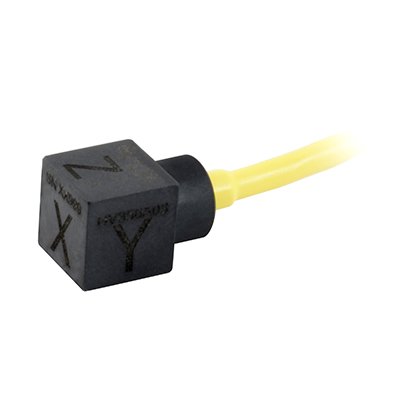
To bridge the gap between high-fidelity data and electrical safety, PCB Piezotronics has developed the HV356A Series of triaxial ICP® accelerometers.
Non conductive polymer housing
Unlike standard sensors, the HV356A features a rugged polymer housing. This innovation provides robust electrical isolation up to 2,000 VDC without significant gain in mass or loss of frequency response. Engineers can now perform direct-contact measurements on live battery structures with total confidence.
Visual Safety: The Double-Jacketed Cable
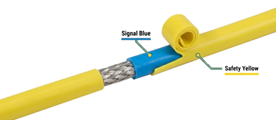
Cable integrity is paramount in HV environments. The series uses a double-jacketed 034-type cable designed for high abrasion resistance. A key safety feature is the visual wear indicator: if the outer yellow jacket is compromised, a blue second layer becomes visible, alerting the team to remove the unit from service immediately.
Customised connectivity
For a truly isolated signal chain, we offer custom terminations, including LEMO Redel 2P plastic connectors. These connectors ensure that no metallic path exists from the sensor to the DAQ, providing a “safety-first” connection in harsh mechanical environments
As EV systems evolve, so must our tools. By eliminating the conductive path and prioritising inherent protection, the HV356A series ensures that the next generation of batteries is as safe as it is powerful
Request a visit from a local engineer
Let’s review your assets and objectives on-site: book an onsite meeting and application review.