Integrating the 3753A into Automotive Test Programmes: a compact triaxial capacitive MEMS (single-ended)
Automotive development is under sustained pressure to deliver faster correlation and higher confidence test data across NVH, powertrain electrification, and durability / Road Load Data Acquisition (RLDA) programmes.
In that context, teams increasingly need sensors that are small, rugged, stable over temperature, and easy to integrate with pragmatic DAQ set-ups—without compromising test efficiency.
The 3753A triaxial variable-capacitance (VC) accelerometer is designed for exactly that “high-use, high-uptime” zone: a low-cost, small-form-factor triax sensor intended for long-duration vehicle and rig work, including water-exposed installations.
Why VC triax accelerometers matter in automotive durability and RLDA
For RLDA and durability, the measurement problem is not just amplitude—it’s repeatability over long runs, across climate cycles, and with real-world installation constraints (limited space, harsh splash zones, long cables, fast turnaround between vehicles). RLDA campaigns are a core automotive workflow to derive load spectra and correlate road-to-rig durability.
VC sensors are often selected when teams prioritise:
- Stability over temperature (minimising drift across environmental exposure)
- Robustness for on-vehicle mounting
- Low power and pragmatic DAQ compatibility for multi-channel deployments
3753 at a glance
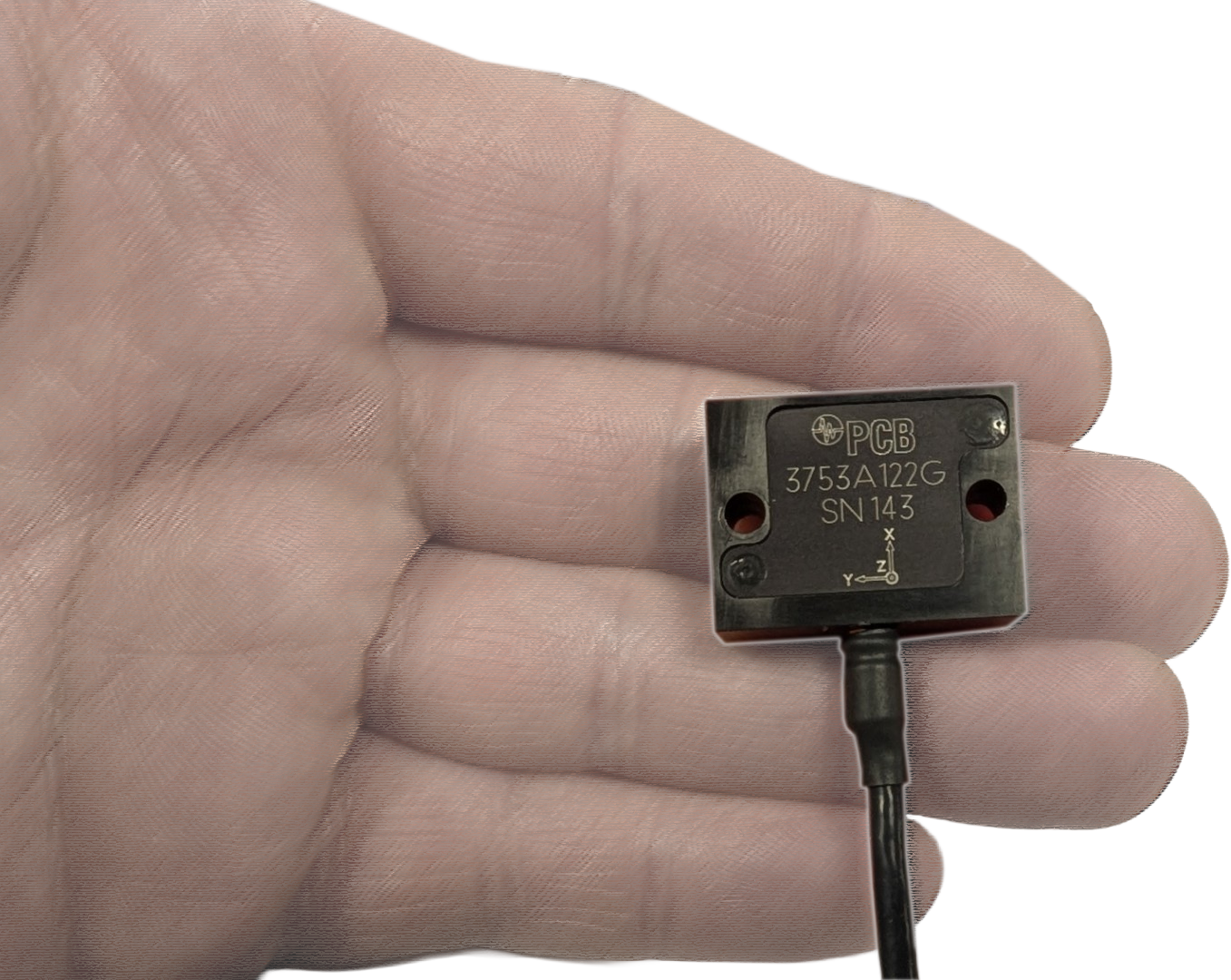
Mechanical & environmental fit
- IP67 sealing for wet/dirty test environments (proving grounds, spray, winter test exposure)
- 12 g mass and compact package (19.1 × 25.4 × 8.9 mm) to reduce installation intrusiveness on light structures
Measurement performance characteristics
- Selectable ranges: 2, 5, 10, 20, 40 g (useful from low-level body responses through higher-amplitude chassis events)
- Frequency response: 550 Hz @ 5% (aligned with many durability / ride / structural use cases rather than high-frequency gear-mesh work)
- Transverse sensitivity: described as “almost non-measurable” (practically helpful when you want clean axis separation in tight mounting conditions)
- Thermal coefficient: ±1% from -40 to +121°C, positioned as better than 3743 or 7290 in that respect
Integration pragmatics
Single-ended output, intended to pair well with lower-cost DAQ architectures and “unique DAQ” constraints—especially common in instrumented vehicles and fleet-style durability campaigns.
Where it fits best in automotive programs
RLDA and durability on vehicle and rigs
Typical 3753A placements include:
- Body/chassis locations for global vehicle response monitoring
- Subframe and suspension attachments where packaging and sealing matter
- Battery pack / enclosure monitoring where water and debris exposure is a real constraint
NVH support measurements where packaging and throughput dominate
NVH teams need accurate data across varied conditions while limiting set-up time and sensor downtime.
The 3753A is relevant when the priority is fast installs, robust survivability, and sufficient bandwidth for many structural NVH tasks—especially during early screening, vehicle comparison tests, and multi-point diagnostics.
Motorsport and “time-poor” test environments
Motorsport instrumentation often values small size, low mass, quick changeovers, and weather resistance. The 3753A’s form factor and IP67 rating align well with those realities, particularly for structural and ride inputs rather than ultra-high-frequency phenomena.
Aero / flutter-type work where axis purity and stability are valuable
In experimental setups where you want clean triax capture with minimal transverse coupling—and stable performance through temperature shifts—the 3753A can be a pragmatic option, provided the bandwidth and noise floor align with the test objective.